earth Water
Direct solar desalination is used to desalinate ocean salt water.
The project is dedicated to providing smallholder farmers with low-tech desalination solutions.
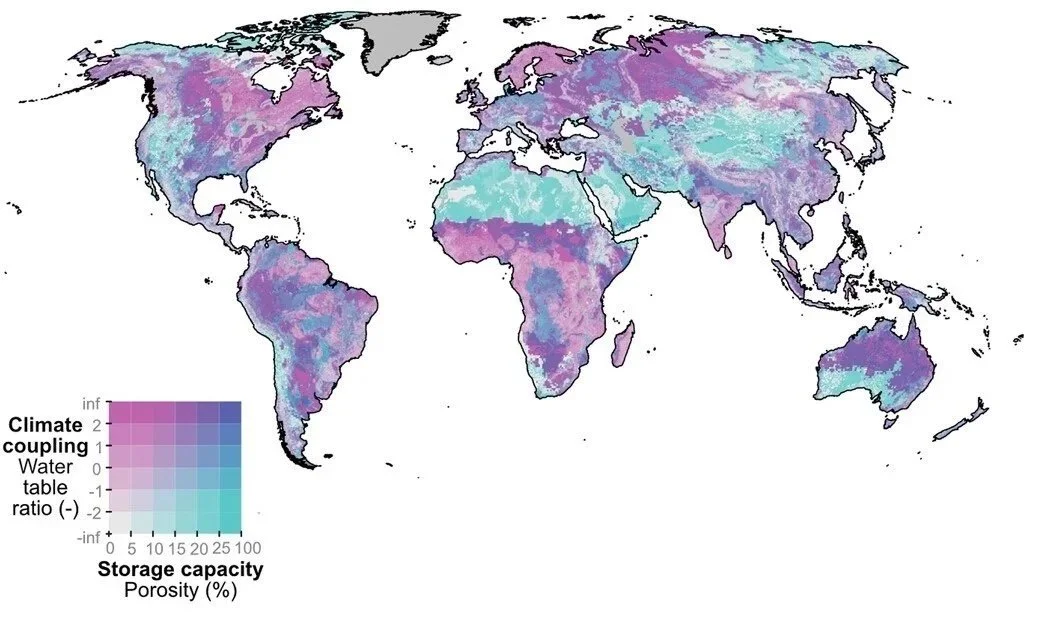
(Huggins et al., 2024)
scarce water resources
One problem is that groundwater resources, particularly those near coastlines, are becoming depleted due to usage and high temperatures. This issue is further exacerbated by climate change. Additionally, saltwater intrusion is occurring, with saltwater seeping into groundwater resources.
Direct solar desalination
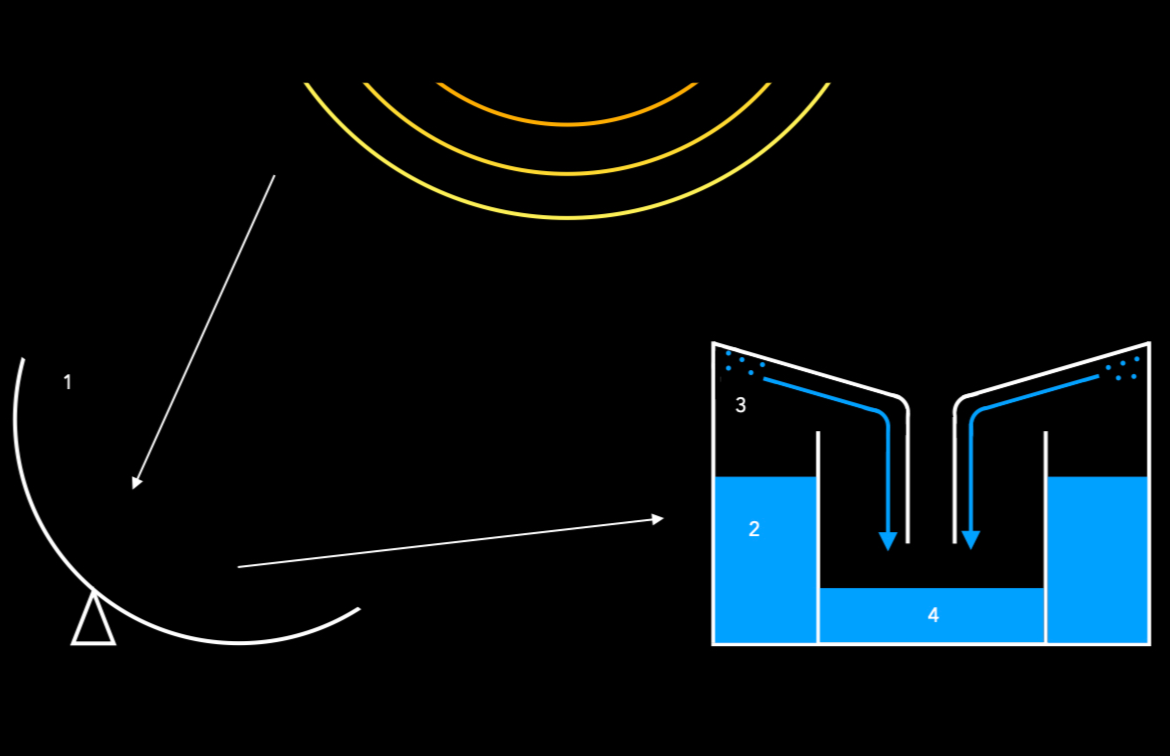
One parabolic dish is used to create high temperatures.
-
Concentrating sunlight produces temperatures of several hundred degrees.
-
The salt water begins to boil. Only the freshwater evaporates.
-
The water condenses on the cooler upper pane before draining away.
-
Freshwater is stored in a tank.
Problem
The problem isn't that there's too little water on Earth; rather, it's that there's too little salt-free water. Therefore, we're trying to find a way to utilise this abundant saltwater resource for small-scale farmers. It is important that the system can be replicated anywhere on Earth using the simplest and most affordable materials possible and a low-tech approach. Furthermore, the approach should be sustainable. Currently, water is mostly desalinated using reverse osmosis desalination, which uses up a lot of fossil fuels like oil to produce energy.
Impact
The application would create further innovation and jobs locally. It addresses the issue of limited arable land and can be used alongside drip irrigation. Direct solar desalination is often not commercially viable because it is less efficient than reverse osmosis desalination using solar cells. However, direct solar desalination has a simpler design, doesn't use rare earth elements, and can still utilise solar power.
Key activities in innovation systems
1. Entrepreneurial activity (4/5): There has been strong innovation in water-saving technologies, with several start-ups and investments. There is uncertainty about scalability.
2. Knowledge development (5/5): There has been a rapid increase in the technological performance of solar panels and desalinated water for irrigation.
3. Knowledge diffusion through networks (2/5): Some workshops and conferences have been held. Further knowledge sharing is required.
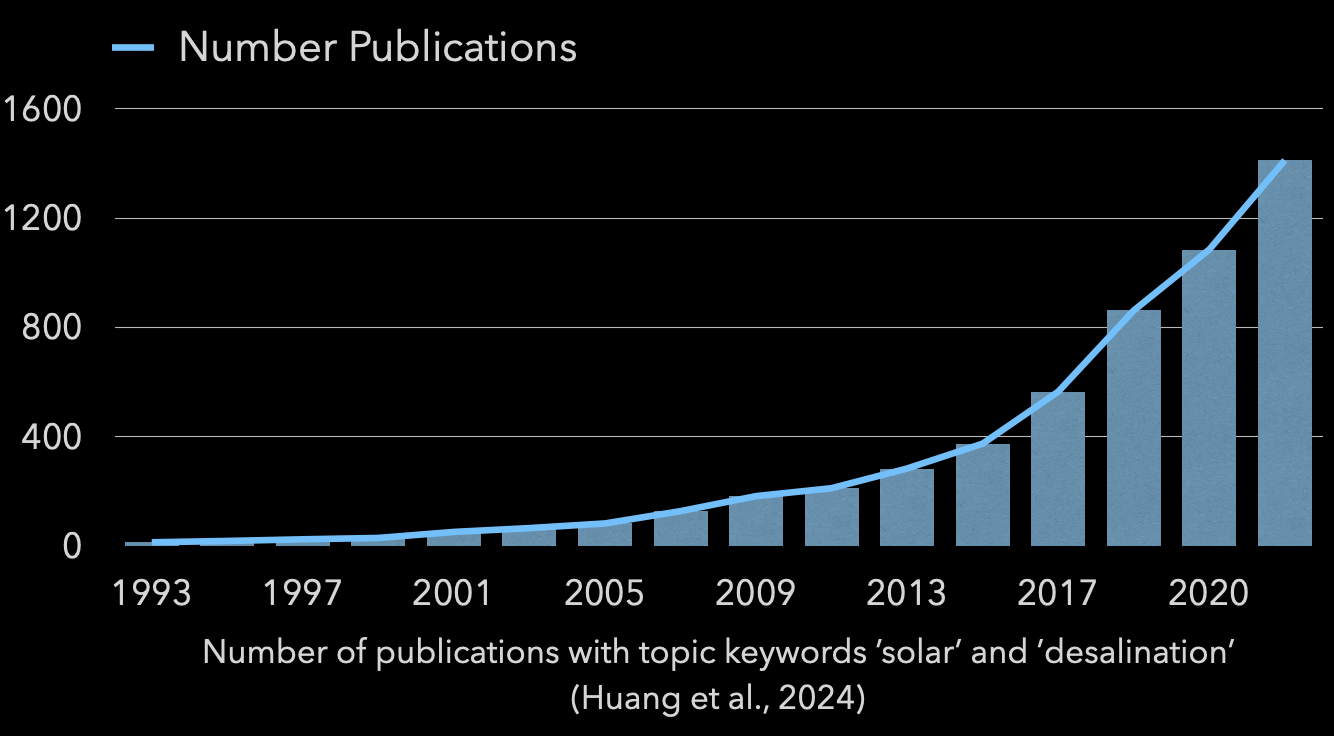
4. Guidance of search(5/5): Mapping the number of articles in journals.
5. Market formation (2/5): The EU Water Framework Directive aims to achieve good status in all water sources (De Stefano et al., 2015). A market for water-saving technology already exists and is likely to grow (e.g. greenhouses, drip irrigation and hydroponics). However, only niche markets exist for direct solar thermal distillation. The EU has an emissions trading system for energy saving and a bio logo to enhance soil. The aim is to achieve net zero greenhouse gas emissions by 2050 (IPCC, 2022).
6. Creation of legitimacy (4/5): Some water users recognise the need to conserve water sources and utilise alternative water sources (De Stefano et al., 2015).
Ahmadi, E., McLellan, B., Ogata, S., Mohammadi-Ivatloo, B., & Tezuka, T. (2020). An Integrated Planning Framework for Sustainable Water and Energy Supply. Sustainability, 12(10), 4295. https://doi.org/10.3390/su12104295
Bamasag, A., Almatrafi, E., Alqahtani, T., Phelan, P., Ullah, M., Mustakeem, M., Obaid, M., & Ghaffour, N. (2023). Recent advances and future prospects in direct solar desalination systems using membrane distillation technology. Journal of Cleaner Production, 385, 135737. https://doi.org/10.1016/j.jclepro.2022.135737
De Stefano, L., Fornés, J. M., López-Geta, J. A., & Villarroya, F. (2015). Groundwater use in Spain: An overview in light of the EU Water Framework Directive. International Journal of Water Resources Development, 31(4), 640–656. https://doi.org/10.1080/07900627.2014.938260
Hekkert, M. P., Suurs, R. A. A., Negro, S. O., Kuhlmann, S., & Smits, R. E. H. M. (2007). Functions of innovation systems: A new approach for analysing technological change. Technological Forecasting and Social Change, 74(4), 413–432. https://doi.org/10.1016/j.techfore.2006.03.002
Huang, J., Zheng, H., & Kong, H. (2024). Key pathways for efficient solar thermal desalination. Energy Conversion and Management, 299, 117806. https://doi.org/10.1016/j.enconman.2023.117806
Huggins, X., Gleeson, T., Villholth, K. G., Rocha, J. C., & Famiglietti, J. S. (2024). Groundwaterscapes: A global classification and mapping of groundwater's large‐scale socioeconomic, ecological, and Earth system functions. Water Resources Research, 60(10). https://doi.org/10.1029/2023WR036287
Ipcc. (2022). Global Warming of 1.5°C: IPCC Special Report on Impacts of Global Warming of 1.5°C above Pre-industrial Levels in Context of Strengthening Response to Climate Change, Sustainable Development, and Efforts to Eradicate Poverty (1. Aufl.). CambridgeUniversityPress. https://doi.org/10.1017/9781009157940
Richardson, K., Steffen, W., Lucht, W., Bendtsen, J., Cornell, S. E., Donges, J. F., Drüke, M., Fetzer, I., Bala, G., Von Bloh, W., Feulner, G., Fiedler, S., Gerten, D., Gleeson, T., Hofmann, M., Huiskamp, W., Kummu, M., Mohan, C., Nogués-Bravo, Rockström, J. (2023). Earth beyond six of nine planetary boundaries. Science Advances, 9(37). https://doi.org/10.1126/sciadv.adh2458
Rosa, L., & Gabrielli, P. (2023). Achieving net-zero emissions in agriculture: A review. Environmental Research Letters, 18(6), 063002. https://doi.org/10.1088/1748-9326/acd5e8